Affiliate Disclaimer: This post may contain affiliate links to relevant tools. We only recommend tools that are contextually useful.
The AI app builder market exploded in 2025–2026, with over 60 platforms launching and valuations reaching billions. Among them, Lovable has emerged as a leading contender, reaching a $6.6 billion valuation and attracting over 1.8 million users in its first year . But what makes an AI app builder truly "best in class" in 2026? Unlike traditional no-code builders that rely on drag-and-drop interfaces, modern AI builders like Lovable generate full-stack web applications from natural language prompts — a paradigm shift that's fundamentally changing how software is built.
In this comprehensive review, We'll analyze Lovable's features, pricing model, and real-world performance. We'll explore why AI app builders are rapidly outpacing traditional no-code platforms for web prototyping and MVP development, while being honest about where they still fall short. Whether you're a solo founder validating an idea, a product manager building internal tools, or a developer looking to accelerate your workflow, this guide will help you decide if Lovable is the right AI app builder for your 2026 projects.
The shift from "no-code" to "AI-native" isn't just semantic. Traditional platforms like Bubble and Adalo require you to learn visual logic systems and database relationships. AI builders eliminate that learning curve entirely — you simply describe what you want. As we'll see, Lovable excels at turning those descriptions into clean, production-ready React code with Supabase backends. But the credit-based pricing model and the "last mile" problem of taking AI-generated code to production are critical considerations before you commit.
What is Lovable? The AI App Builder Explained
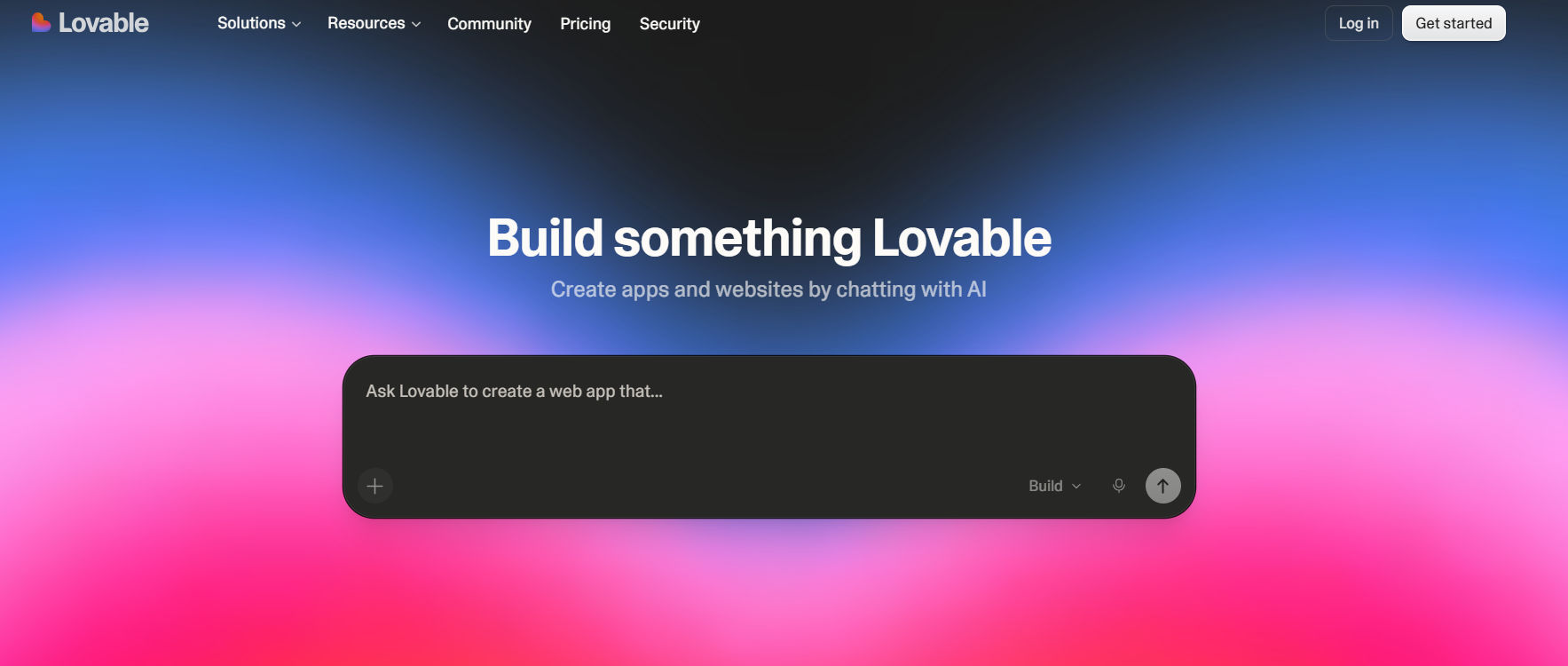
Lovable (formerly GPT Engineer) is an AI-powered full-stack web application builder that generates code from natural language prompts. Launched in 2024, the platform grew to over 1.8 million users within its first year and ranks #1 among prompt-to-app builders in independent industry reports . Unlike traditional no-code tools that provide visual canvases, Lovable operates through a chat interface where you describe your application, and the AI writes the React, TypeScript, and Tailwind CSS code for you.
The platform's core architecture revolves around three integrated components. First, the AI generation engine — powered by Gemini Flash 2.0 — interprets your prompts and generates frontend components, page routing, and UI layouts . Second, Lovable includes deep native integration with Supabase, automatically generating database schemas, row-level security policies, authentication flows, and API endpoints alongside your frontend code . Third, one-click deployment pushes your app live on a Lovable subdomain or a custom domain on paid plans.
Where Lovable differentiates itself from pure code generators like V0 or Cursor is its full-stack scope. V0 generates individual React components — you still need to assemble them into an application. Cursor accelerates existing developers but assumes you know how to structure a project. Lovable, in contrast, attempts to build complete, database-backed web applications from a single conversation. This positions it as an all-in-one AI app builder for founders and non-technical creators who need working software without managing infrastructure.
Lovable Features: What You Can Actually Build
Lovable's feature set is designed around the prompt-to-app workflow, with several capabilities that justify its "leading AI app builder" reputation. The default mode is conversational generation: you type what you want — "Build a dashboard with user authentication and a task management table" — and Lovable creates pages, logic, and components. The system generates a real-time preview as it writes code, so you see your application taking shape within seconds .
Beyond basic generation, Lovable includes a visual diff viewer that highlights exactly what the AI changed between iterations — crucial for understanding modifications without manually reviewing every line of code. The platform also supports Figma import, converting your design files into working React components, which bridges the gap between design tools and functional software .
For version control and collaboration, Lovable integrates directly with GitHub, allowing you to sync generated code, manage branches, and collaborate with team members. Multiplayer editing enables multiple users to work on the same project simultaneously, though permissions are relatively basic compared to enterprise-focused platforms . Paid plans unlock Code Mode, which gives you direct access to edit the generated React code when the AI's interpretation doesn't match your requirements.
Deployment is streamlined through one-click hosting on Lovable's infrastructure, with custom domain support on Pro plans and above. The platform also includes built-in security scanning, though a documented CVE in 2025 highlighted that AI-generated authentication logic can sometimes invert permissions — a reminder that generated code still requires human review for production workloads .
Lovable Pricing: Credit System Deep Dive
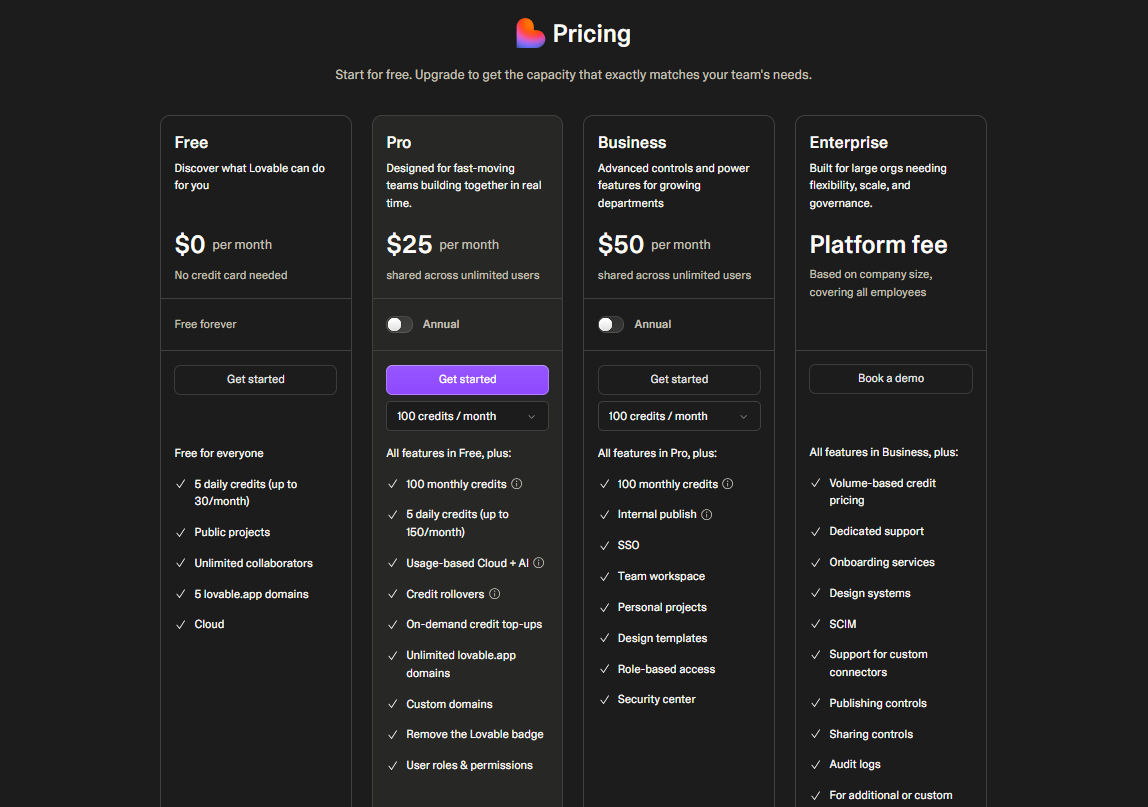
Lovable uses a credit-based pricing model that has drawn both praise and criticism. The free tier provides 5 credits per day, capped at 30 credits per month — enough to explore the basics but insufficient for any serious project. Simple chat messages cost 1 credit each, while larger AI tasks like generating new pages or refactoring code cost between 3–5 credits depending on complexity .
The paid plans start at the Pro tier at $25 per month, which includes 100 monthly credits plus the daily 5 credits. This gives you approximately 130–150 credits per month. The Growth plan costs $50 per month with 300 monthly credits, and custom enterprise pricing is available for larger teams . Monthly credits roll over to the next month, but daily credits do not — a detail that matters for usage planning.
Where the credit system becomes controversial is in its unpredictability. Users have reported burning 400 credits in under an hour during complex iteration sessions where the AI gets stuck in debugging loops . Each fix attempt consumes credits, and if the AI introduces new errors while fixing old ones — a common complaint — you can cycle through credits rapidly without making progress. Independent analysis suggests typical consumption runs 15–25 credits per hour of active development, meaning the Pro plan's 100 monthly credits might only deliver 4–6 hours of productive work .
For context, building a production-ready web app with Stripe integration, user authentication, and a database might require 40–60 hours of iteration. At 20 credits per hour, that's 800–1,200 credits — far exceeding the Pro plan's allowance. Users have documented spending $939 total on single projects when factoring in credit overages and remediation costs . This "credit trap" is the #1 stated reason developers switch away from Lovable to alternatives with flat-rate pricing.
Lovable Pros: Where This AI App Builder Excels
Despite the pricing concerns, Lovable delivers genuine value in specific scenarios. The speed from idea to working prototype is genuinely impressive. One user reported completing "6 months of work in 2 days" using Lovable, and independent tests confirm you can go from blank workspace to a functional UI in under 10 minutes . For validating concepts, pitching to investors, or building internal tools for small teams, this acceleration is transformative.
The full-stack generation capability sets Lovable apart from frontend-only tools like V0. When you describe a complete application, Lovable doesn't just generate the UI — it creates the Supabase database schema, row-level security policies, authentication flows, and API endpoints automatically . This means you can build a working app with user accounts and data persistence without configuring any backend services manually. For non-technical founders who need to test a SaaS idea, this is the difference between "I have a design" and "I have a product."
The output code quality is consistently high. Senior engineers who have reviewed Lovable's generated React code describe it as "very clean" — production-adjacent quality that would pass most code reviews . The use of Tailwind CSS for styling and shadcn/ui for components means the generated interfaces are modern, responsive, and accessible by default. Developers can take the exported GitHub repository and continue working in their own IDE without fighting the AI's output.
Lovable's tight Supabase integration is a genuine differentiator. While other AI app builders generate frontend code and leave you to figure out the backend, Lovable handles the entire stack. This reduces the "MVP gap" — the distance between a prototype and something you could actually charge users for — more effectively than any other prompt-to-app tool in the 2026 market .
Lovable Cons: The Credit Trap and Production Limits
The most significant drawback is the credit-based pricing model, which creates what users call "generation anxiety" — the reluctance to experiment or iterate freely because every prompt consumes limited credits . Complex features like Stripe integration or multi-step user flows often require 10–20 fix iterations, each burning credits. When the AI misunderstands your request or introduces new bugs while fixing old ones — both common complaints — you can exhaust your monthly credits without achieving your goal.
Beyond pricing, Lovable has documented production limitations. Independent research shows that Lovable-generated prototypes typically handle only 5–10 concurrent users with 3–5 second load times before requiring significant remediation . Taking an AI-generated app to production — with proper error handling, performance optimization, security hardening, and scalability — costs an estimated $5,000+ and 4–6 weeks of developer time . The platform is widely described as a "first 70–80% tool": start here, then finish in a professional development environment.
Security is another concern. A CVE in 2025 exposed 18,697 user records across 170+ Lovable apps when the AI inverted authentication logic, blocking legitimate users while allowing anonymous access . A broader scan of approximately 4,000 Lovable apps found 2,000+ vulnerabilities and 400+ exposed secrets. While Lovable's CISO has acknowledged these gaps, the platform is not yet suitable for applications handling sensitive data or payments without thorough security review.
The iteration wall is a frequently reported frustration. 65–75% of developers experience "looping" — where the AI rewrites entire files instead of making targeted changes, creating cascading failures that drain credits without resolving the underlying issue . Minor changes can introduce modifications in unexpected files, and it's often difficult to trace where errors originated. For complex applications with custom business logic, the prompting workflow becomes more time-consuming than simply writing the code yourself.
Lovable vs Traditional No-Code Builders: Why AI is Winning
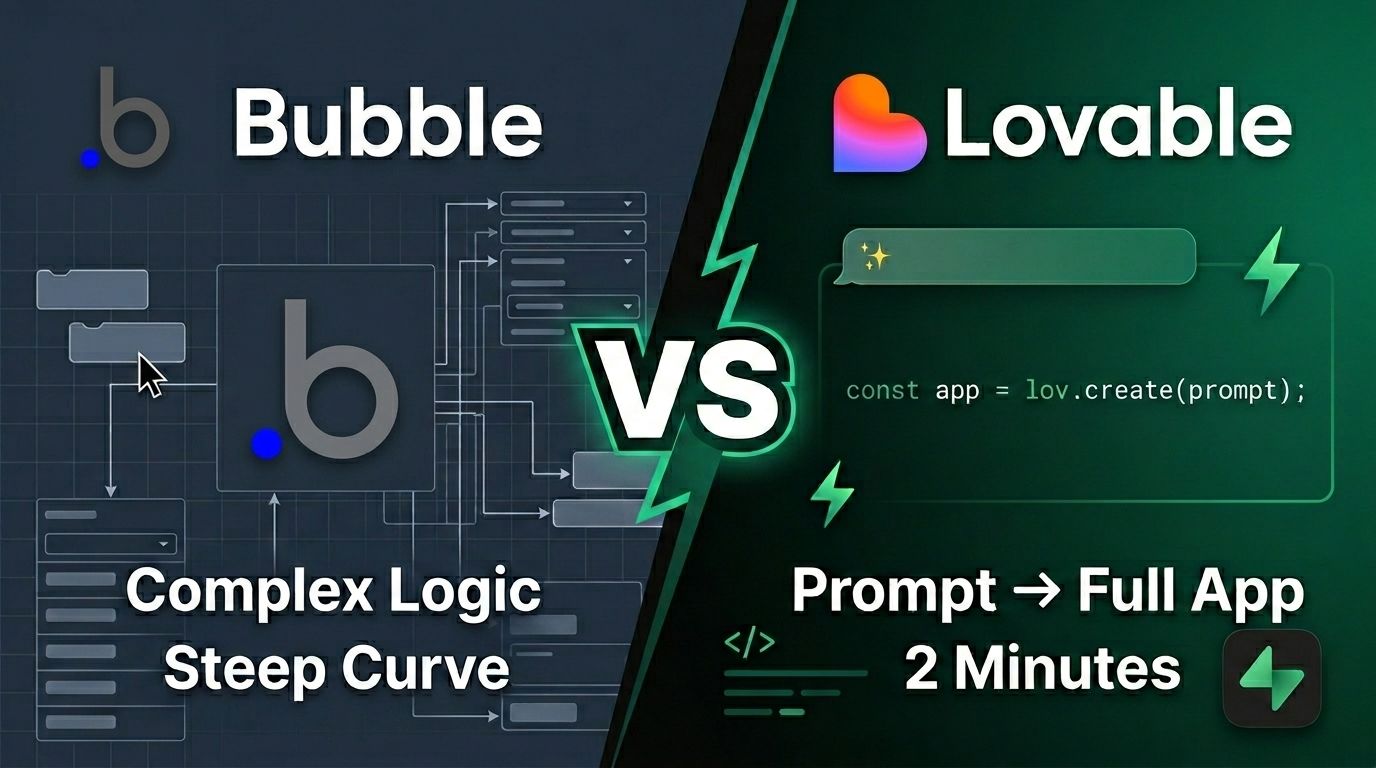
The fundamental difference between AI app builders like Lovable and traditional no-code platforms like Bubble or Adalo is the abstraction layer. Traditional no-code tools replace code with visual logic systems — you still need to understand database relationships, API calls, and conditional workflows, but you configure them through dropdowns and drag-and-drop interfaces. The learning curve is shallower than coding, but it's not zero. AI builders eliminate that curve entirely: you describe what you want in plain English, and the AI figures out the implementation .
This shift explains why AI app builders are trending in 2026. Traditional no-code platforms require you to think like a developer — just without typing syntax. AI builders let you think like a product owner. The cognitive load shifts from "how do I configure this component to do X?" to "what do I want X to be?" For non-technical founders, product managers, and business users, this is revolutionary .
However, traditional no-code platforms have advantages that AI builders haven't yet matched. Adalo, for example, publishes true native iOS and Android apps directly to the Apple App Store and Google Play — something Lovable cannot do, as it generates web-only React code . Traditional platforms also offer predictable flat-rate pricing ($36/month for Adalo's starter plan) versus Lovable's variable credit costs. And for long-term maintenance, traditional no-code platforms handle infrastructure, security patches, and scaling automatically — with AI-generated code, you own the maintenance burden.
The emerging best practice is hybrid: use AI app builders for rapid prototyping and validation, then rebuild or migrate to traditional no-code platforms (or custom development) when you need production-grade reliability, native mobile apps, or predictable costs. Lovable is excellent for the "does this idea work?" phase. For the "we have 10,000 paying users" phase, you'll likely need a different stack .
Lovable Competitors: How Other AI App Builders Stack Up
The AI app builder landscape in 2026 includes several strong alternatives to Lovable, each with different trade-offs. Bolt.new (by StackBlitz) runs a full Node.js environment directly in the browser using WebContainers, offering the fastest iteration cycle for frontend prototyping. It's token-based like Lovable, but focuses exclusively on frontend code — you handle backend, database, and deployment yourself. Best for developers who want AI assistance but don't need full-stack generation .
V0 by Vercel generates individual React components using shadcn/ui and Tailwind CSS, producing the highest-quality component-level output in the market. It does not build full applications — you use V0 to generate pieces, then assemble them in your own codebase. For teams already in the Vercel ecosystem, V0 is a natural productivity multiplier. For complete apps, it solves only a fraction of the problem .
Cursor is an AI-enhanced code editor (VS Code fork) that auto-completes, refactors, and generates code in context. It's not an app builder — it's an accelerator for developers who already write code. With a $29.3 billion valuation and $2 billion in ARR, Cursor is the most commercially successful AI coding tool, but it assumes you know how to structure applications, manage databases, and deploy to production .
Replit Agent offers a full cloud development environment with AI assistance baked in. It supports multiple programming languages (not just React) and handles hosting directly. The sweet spot is developers who want AI help but prefer to maintain full control over their codebase. Unlike Lovable, Replit doesn't abstract away the development environment — you're still working with files, terminals, and package managers .
For teams that need production-grade internal tools, DronaHQ combines visual building with AI assistance, offering enterprise features like fine-grained RBAC, audit logs, and multiple environments. It's less focused on rapid prototyping and more on building reliable business applications that teams depend on for months or years .
Use Cases: Who Should Use Lovable in 2026
Solo founders validating SaaS ideas. Lovable's sweet spot is the earliest stage of product development. If you have an idea for a web application and need to test whether anyone will use it, Lovable can get you from concept to clickable prototype in an afternoon. The generated code is clean enough to demo to investors or early beta users. Just be realistic that the prototype will need significant work before handling real production traffic .
Product managers building internal tools. For internal dashboards, admin panels, and team utilities that will be used by 5–50 people, Lovable is often sufficient without additional development. The 5–10 concurrent user limit isn't a problem for internal tools with light usage patterns, and the cost structure is manageable for short-lived projects. Many product teams use Lovable to build tools that would otherwise wait months for engineering bandwidth .
Backend developers who hate frontend work. If you know how to build APIs and manage databases but dread writing React components, Lovable is a legitimate productivity tool. Generate the UI with prompts, then connect your existing backend logic. This hybrid approach — AI for frontend, manual for backend — avoids many of Lovable's limitations while leveraging its strengths .
Hackathon teams and rapid prototyping. When speed matters more than long-term maintainability, Lovable is hard to beat. Teams have built functional prototypes in hours rather than days, validating concepts that would be impossible to test under traditional development timelines. For hackathons, pitch competitions, or internal innovation sprints, the credit costs are acceptable given the time savings .
Non-technical creators learning to build. Lovable serves as an interactive learning tool. By generating working code from natural language descriptions, it helps non-technical users understand what's possible and how applications are structured. Some users start with Lovable, then gradually learn to edit the generated code directly as their skills improve .
FAQ: Your Lovable Questions Answered
Is Lovable free? Lovable has a free tier with 5 credits per day, capped at 30 credits per month. This is sufficient for basic exploration but insufficient for any serious project. Paid plans start at $25/month .
How much does Lovable actually cost for a real project? The $25/month Pro plan provides approximately 100 monthly credits. At typical consumption of 15–25 credits per hour, this delivers 4–6 hours of active development per month. Users have reported spending $939 total on single projects when factoring in credit overages and remediation costs. Production remediation for serious apps starts at $5,000+ .
Can Lovable build mobile apps? No. Lovable generates web-only React code. It does not produce native iOS or Android apps. Apple rejects wrapped websites under Guideline 4.2, so you cannot publish Lovable-generated apps to the App Store. For native mobile apps, consider traditional no-code platforms like Adalo .
What's the difference between Lovable and Bolt.new? Lovable generates full-stack apps with integrated Supabase backends. Bolt.new focuses on frontend prototyping and generates code you must deploy yourself. Lovable is better for non-technical users who need a complete working app; Bolt.new is better for developers who want AI assistance on frontend code .
Is Lovable production-ready? For simple web applications with light traffic (5–10 concurrent users), Lovable can be production-ready with minimal additional work. For applications handling payments, sensitive data, or significant traffic, you should expect to invest $5,000+ and 4–6 weeks of developer time to remediate the generated code for production use .
Does Lovable own my code? No. You own the code generated by Lovable. You can export it to GitHub and deploy it anywhere. This is a key advantage over traditional no-code platforms where you cannot export your application logic .
What are the main limitations of Lovable? The three biggest limitations are: (1) credit-based pricing makes costs unpredictable, (2) complex apps get stuck in debugging loops that drain credits, and (3) production scaling requires significant remediation work. The platform excels at prototypes but struggles with production-grade applications .
Verified Partner Deal
Build Your Full-Stack Web App Free
Turn natural language into production React & Supabase apps. 5 free daily credits.
Start Building Free